

 Kamil "Ravik" Borkowski
Imagine browsing AK-47 skin listings and finding two almost identical items. The same skin name, the same wear condition and, at first glance, practically the same appearance. One costs a few hundred dollars, while the other is listed for several times more.
A pricing mistake? Not necessarily.
After taking a closer look, you discover that the more expensive skin has an extremely low float, a rare pattern and a set of old stickers that are no longer easy to obtain. Suddenly, its price no longer seems quite so absurd.
That is why the answer to the question “Why are CS2 / CS:GO skins so expensive?” cannot be reduced to a single sentence. The value of an item is influenced by its rarity, appearance, origin, availability, popularity among players and the unique properties of that particular copy.
On top of that, there are emotions, trends, speculation and Valve’s decisions, which can change the situation across the entire market in a single day. There is also one very common mistake players make when valuing skins. We will return to it near the end of the article.
Where did the high prices of Counter-Strike skins come from?
Skins became part of Counter-Strike in 2013, when Valve introduced the Arms Deal update. The game received cases, keys, decorated weapons, player-to-player trading and the ability to list items on the Steam Community Market.
That was the moment when colourful textures stopped being nothing more than cosmetic additions. They began functioning as digital collectibles that could be obtained, traded and sold.
A skin does not increase damage, improve accuracy or reduce recoil. It gives you no direct advantage over your opponent. Its value comes from the fact that other players want to own it.
The mechanism is similar to the market for collectible cards, limited-edition sneakers or watches. The practical function of an item does not fully explain its price. What matters is availability, history, appearance, recognisability and how much a potential buyer is willing to pay.
In CS2, there is one more important factor - you actually use the skin in the game. You see it during every round, you can show it to other players and you can match it with the rest of your loadout.
Why are skins in CS so expensive?
The simplest answer is this: the most expensive skins are extremely rare, while a large number of players want to own them.
Rarity alone is not enough, however. The market contains some very difficult-to-obtain skins that do not reach astronomical prices because their appearance or base weapon is not especially popular.
The price of a skin may depend on:
- the rarity of the item,
- the current number of available copies,
- the popularity of the weapon,
- visual appeal,
- float and wear condition,
- pattern,
- collection or case,
- stickers,
- StatTrak or Souvenir status,
- trends within the community,
- market liquidity.
The highest-valued skins usually combine several of these qualities at once. An item may come from an unavailable collection, have an attractive design, an extremely low float and a pattern sought after by collectors. Each of these traits adds another layer to its value.
Skin rarity does not always tell the whole story
Counter-Strike items are divided into rarity tiers. Weapon skins include categories such as Mil-Spec, Restricted, Classified and Covert. Knives and gloves belong to a separate group of exceptionally rare special items.
It therefore seems logical to assume that the higher the rarity, the more expensive the skin. In practice, it does not always work that way.
A Covert skin may come from a popular case that has been opened millions of times. Despite its high rarity tier, a considerable number of copies may still exist on the market.
On the other hand, an item from a lower rarity tier may belong to an old operation collection that has not been available for years. As a result, almost no new copies enter circulation, while existing items are gradually consumed in trade-up contracts.
The rarity displayed in the game does not always equal real market scarcity.
When valuing a skin, it is worth checking more than the colour of its rarity tier. Look at:
- how many listings are currently available,
- how often the skin appears on the market,
- whether its case is still dropping,
- whether the collection may return,
- whether the skin is used in popular trade-up contracts.
Actual supply usually tells you much more than a Covert or Classified label.
How does float affect a skin’s price?
Float is a value that determines the wear level of a specific skin. It usually ranges from 0 to 1. The lower the number, the cleaner the skin generally looks, with fewer scratches and visible signs of wear.
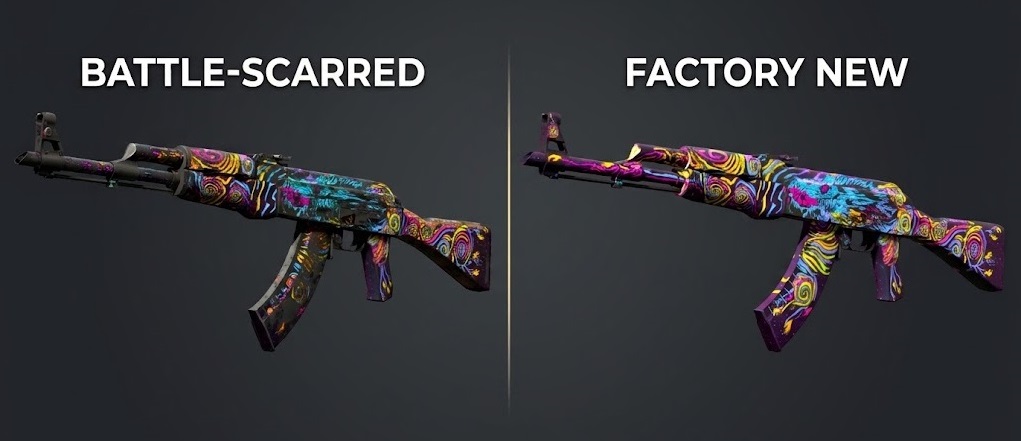
Original graphic by the editorial team
The most common wear conditions are:
| Skin condition | Float range |
| Factory New | 0.00-0.07 |
| Minimal Wear | 0.07-0.15 |
| Field-Tested | 0.15-0.38 |
| Well-Worn | 0.38-0.45 |
| Battle-Scarred | 0.45-1.00 |
This does not mean that all skins within one condition look exactly the same.
Two Factory New skins can be very different
A skin with a float of 0.069 still belongs to the Factory New category. The same is true for an item with a float of 0.002. The visual difference may nevertheless be significant, especially in finishes that show scratches easily.
For an average player, both items may look good enough. A collector, however, will pay attention to the exact float value rather than the condition name alone.
The closer a skin is to its minimum possible float, the larger the collector premium may become.
Items at the top of float rankings can be especially expensive. If a skin has the lowest known float in the world, its price may have very little to do with the standard value of an ordinary Factory New copy.
Even the digits themselves can matter. Some collectors look for floats containing specific sequences, dates or repeating numbers.
Does a high float always mean a cheap skin?
No. This is one of the areas where the skin market can be surprising.
In many cases, players do prefer cleaner items. Some skins, however, develop an interesting or recognisable appearance at very high wear levels. A heavily worn Battle-Scarred copy may then attract more attention than an average Field-Tested one.
A high float may increase the value when:
- the item is close to the maximum possible float,
- the wear creates a distinctive visual effect,
- the variant has become popular within the community,
- very high-float copies are unusually rare.
You should not automatically assume that every low float is good and every high float is bad. The most important question is how the float affects the appearance of that particular skin.
A pattern can change a skin’s price by thousands
A pattern determines how the design is placed on the weapon, gloves or knife model. Two items with the same name and identical float can therefore look completely different.
For many skins, the difference is minor and has little impact on value. There are, however, several finishes where the pattern is one of the most important parts of the valuation.
The best-known examples include:
- Case Hardened,
- Fade,
- Doppler,
- Gamma Doppler,
- Crimson Web,
- Slaughter,
- Marble Fade.
With Case Hardened skins, patterns containing a large amount of blue are the most desirable. The most exceptional variants are known as Blue Gems and may cost several times more than a standard item with the same name.
For Fade skins, the percentage and placement of colours matter. With Doppler finishes, the phase is extremely important, while special variants such as Ruby, Sapphire and Black Pearl belong to the most sought-after versions.
In the case of Crimson Web, clearly visible webs in prominent positions may increase the value. With Slaughter, some collectors pay attention to layouts that resemble particular shapes or symbols.
You cannot accurately value a premium-pattern skin based only on its name and wear condition. You need to check the pattern index and inspect the item carefully in the game.
The case and collection affect the number of available skins
A skin’s price also depends on whether new copies can still enter the market regularly.
Skins may come from:
- active cases,
- rare cases,
- operation collections,
- limited-time events,
- souvenir packages,
- trade-up contracts.
If a case is popular and regularly obtained by players, its skins continue entering circulation. Supply may remain relatively high, even when the chance of unboxing a particular item is low.
The situation changes when a case moves into the rare drop pool or almost stops dropping. Each opening then reduces the number of unopened cases, while new copies of the contained skins appear more slowly.
This is even more noticeable with operation collections. After an event ends, obtaining new items may become limited or stop completely. Players can still trade existing skins, but the total number of copies no longer grows at the same rate.
Some items also disappear from circulation through trade-up contracts. A skin used in a contract is removed from the inventory, reducing the available supply.
The harder it becomes to create new copies, the more important every existing item becomes.
Weapon popularity translates into demand
A skin for the AK-47, AWP, M4A1-S, M4A4, Desert Eagle, Glock-18 or USP-S usually attracts more interest than an equally rare skin for a weapon used once every few matches.
The reason is simple - players want to buy skins they will actually see during gameplay.
If you use the AK-47 in almost every Terrorist-side gun round, an attractive AK skin may be more valuable to you than an impressive finish for a rarely purchased submachine gun.
Popular weapons also offer better liquidity. It is usually easier to find a buyer for a recognisable AWP skin than for a niche item desired by only a small group of players.
The professional scene matters as well. When a weapon becomes more common in tournaments, interest in its skins may increase. If Valve changes the balance and the weapon falls out of the meta, demand may weaken.
This does not happen immediately after every update, but weapon popularity clearly increases the number of potential buyers.
A skin’s appearance is more than a minor extra
The skin market is largely driven by player preferences. Items that look good, match popular gloves or are frequently shown by professional players and creators may command higher prices.
The most desirable skins often feature:
- vivid colours,
- a clear and recognisable pattern,
- relatively few visible scratches,
- the ability to create a consistent loadout,
- a good surface for stickers,
- an iconic theme.
The knife model also matters. The Butterfly Knife is valued not only because it is rare, but also because of its distinctive draw and inspect animations. The Karambit attracts players with its shape and unique holding style.
A player is not simply buying a texture stored in the game files. They are buying the appearance, animation, presentation and feeling of using that item during a match.
This is why a lower-rarity skin may sometimes cost more than a theoretically better item that simply never became popular with the community.
StatTrak and Souvenir versions may increase the value
StatTrak is a special item version with a kill counter. For popular skins and weapons, the StatTrak version may cost significantly more than the standard copy.
The premium is not always the same. It depends on demand.
StatTrak is particularly attractive on weapons that players use frequently. A kill counter on an AK-47 or AWP is more appealing to many users than one on a weapon purchased only occasionally.
Souvenir items are connected with professional Counter-Strike tournaments. Their value may depend on:
- the tournament,
- the map,
- the match,
- the participating teams,
- the collection,
- the stickers placed on the skin,
- the historical significance of the event.
The Souvenir label alone does not guarantee a high price. Many souvenir skins remain inexpensive. The largest premiums usually appear when an attractive skin, a rare collection and desirable stickers come together.
Stickers can be worth more than the weapon underneath them
Stickers are one of the most complicated parts of skin valuation. In some cases, the base skin is relatively cheap, but the craft placed on it is worth several times more.
The most desirable stickers include:
- old tournament stickers,
- holographic variants,
- stickers of popular teams,
- autographs of famous players,
- complete sets of four matching stickers.
The sticker type is not the only important factor. Placement matters as well. The most visible position on a weapon may be more valuable than a slot partially hidden during gameplay.
Colour coordination also plays a role. Four carefully selected stickers on an attractive skin can create a consistent craft for which a collector may pay a significant premium.
One important rule must be remembered. An applied sticker does not add the full value of an unused sticker to the skin.
Once applied, it cannot be removed and sold separately. The premium therefore depends on how desirable the entire craft is and how many players actually want to own it.
The history of a particular skin may matter
Some items are expensive not only because of their appearance and technical properties, but also because of their history.
A skin may be worth more if it:
- previously belonged to a famous professional player,
- has the lowest known float,
- has one of the highest known floats,
- features a unique sticker combination,
- is one of only a few similar crafts in existence,
- comes from a historically important collection,
- is linked to a major tournament or match.
In such cases, a standard price chart may tell you very little. If only a few comparable copies exist, each transaction may be negotiated individually.
The buyer is no longer comparing the skin with the cheapest listing of the same name. They are looking for an item with a similar float, pattern, history and sticker arrangement.
At this point, the market begins to resemble the trade of traditional collectibles more than the sale of ordinary in-game cosmetics.
The skin market is also driven by speculation
Prices are influenced not only by the actual properties of a skin, but also by player expectations.
The market may react to:
- update announcements,
- new cases,
- new operations,
- Major tournaments,
- changes to trade-up contracts,
- modifications to the drop system,
- videos from popular creators,
- rumours about a collection being discontinued.
When the community expects the supply of certain skins to stop growing, some users begin buying them in advance. The price then rises not only because of genuine player demand, but also because of speculation.
Panic works in a similar way. If an update increases the availability of a particular group of items, many owners may rush to sell. The number of listings rises sharply, while the price may fall within hours.
You also need to distinguish a listing price from an actual sale price.
Someone may list a skin for $20,000, but that does not mean the item is worth $20,000. Only completed transactions show what buyers were genuinely prepared to pay.
The Steam price does not always equal the cash value
When valuing a skin, you must pay attention to where it is being sold.
A price on the Steam Community Market may be higher than the price on external marketplaces. One reason is that money obtained on Steam remains in the platform wallet and cannot normally be withdrawn to a bank account.
Transaction fees also affect pricing.
You should therefore distinguish between:
- Steam price,
- cash price,
- the cheapest active listing,
- the highest buy order,
- the average of recent completed sales.
The difference can be substantial, especially for expensive items.
A skin listed for $2,500 on Steam is not necessarily worth $2,500 in cash. Its realistic value during a quick sale may be considerably lower.
Liquidity also matters. A popular AK-47 skin may find a buyer relatively quickly. A unique and expensive craft may wait for the right collector for weeks or months.
Have skins become more expensive since the CS:GO era?
Many popular and older skins are now more expensive than they were during the CS:GO era. This does not mean that the price of every item increased.
The announcement of CS2 had a major impact. Valve confirmed that player inventories would carry over into the new version of the game. Skins did not disappear, while many of them received updated lighting and improved presentation in the Source 2 engine.
The market reacted with intense interest. Former players returned, new users joined and collectors became increasingly interested in items that could look better after the transition to CS2.
Price growth was supported by:
- the popularity of the CS2 announcement,
- returning members of the community,
- the preservation of existing inventories,
- limited supply of old collections,
- a growing number of collectors,
- speculation before release.
Some skins later experienced corrections. Their prices had risen very quickly because players bought them during the hype, then fell once the excitement began to fade.
Other items did not gain value because they looked worse under the new lighting, lost popularity or continued to have a high supply.
The answer to whether skins became more expensive after CS:GO is therefore: many of them did, but not the entire market and not to the same degree.
A single Valve update can change the entire market
In October 2025, Valve expanded the trade-up contract system. Players gained the ability to use five Covert skins to obtain a knife or a pair of gloves linked to the collections of the submitted items.
The market reacted almost immediately.
Some red-tier skins increased sharply in price because they became ingredients for the new contracts. At the same time, knives and gloves came under price pressure because an additional method of obtaining them had appeared.
This situation demonstrated something extremely important: skin values depend on the rules set by Valve.
Even a rare item may lose part of its value if an update increases its supply. Meanwhile, a previously ordinary skin may suddenly become highly desirable if it gains a new use within the game’s economy.
This is exactly why historical price charts provide no guarantee of future performance.
Are CS skins a good investment?
Skins can become more valuable, but they should not be treated as a safe or predictable investment.
They are digital collectibles whose value depends on player behaviour, Valve’s decisions, supply, the popularity of the game and current market conditions.
A skin:
- does not pay interest,
- does not generate dividends,
- has no guaranteed minimum value,
- may quickly lose liquidity,
- may fall in price after an update,
- requires a secure Steam account,
- may be difficult to sell at the expected price.
On the other hand, some items have increased significantly in value over the years. Old collections, popular knives, rare stickers, low floats and exceptional patterns have often performed particularly well.
This does not mean similar growth will happen again.
Buying a skin only because its price has previously increased is pure speculation. The market may reverse after a single update, a change to the drop system or a decline in interest in a particular collection.
If you are asking whether CS skins are a good investment, the most honest answer is this: they can be interesting collectible assets, but they involve substantial risk and no guarantee of profit.
How can you check the true value of a skin?
Valuing a skin should not consist of entering its name and checking the first listing you see.
How to check a skin’s price step by step
- Check the full skin name and the weapon to which it belongs.
- Verify the wear condition and exact float.
- Check the pattern index and inspect the item in the game.
- Determine whether it is a standard, StatTrak or Souvenir version.
- Analyse the stickers, their placement and whether they have been scraped.
- Check which case or collection the skin comes from.
- Compare completed sales of similar copies.
- Separate the Steam price from the cash value.
- Check the number of listings and the speed at which the skin sells.
- Review recent updates that may affect the item.
The more expensive the skin, the more important it becomes to compare genuinely similar copies.
A standard Factory New price may be irrelevant if the item has a top-ranked float, premium pattern or an old craft with expensive stickers.
Do you need expensive skins to build your inventory?
High prices for collectible items do not mean that every new skin has to involve a large purchase. If you want to explore ways to obtain items without buying them directly, read our guide on how to get free CS2 skins. Always check the requirements of each method and promotion, though: “free” does not necessarily mean there are no prior costs or additional conditions.
Why are CS2 / CS:GO skins so expensive? The key conclusion
Skins are expensive because they combine gaming, collecting and digital trading. For some players, they are a way to personalise their inventory. For others, they represent status, a collectible or a speculative asset.
The most expensive skins are those that are rare, attractive, recognisable and difficult to replace at the same time.
Their price may be influenced by float, pattern, stickers, wear condition, weapon popularity, case availability, collection origin and the history of a specific copy. Trends, Valve updates and the behaviour of the wider market also play a role.
What about the mistake mentioned at the beginning?
The most common mistake is comparing a skin only with the cheapest listing carrying the same name. Two items may look similar in an inventory, while differing in float, pattern, stickers and real value by several times.
Before selling, buying or using a skin in a trade-up contract, check all of its properties. One additional detail may reveal that an apparently ordinary item is worth far more than you initially expected.
Explore the other G4Skins guides to learn more about skins, cases, trade-up contracts and the mechanics of the Counter-Strike 2 economy.
FAQ - common questions about CS2 and CS:GO skin prices
Why are CS:GO skins expensive if they provide no advantage?
Skins have cosmetic and collectible value. Their price depends on rarity, appearance, demand and tradeability rather than on weapon statistics.
Do skins wear out while you play?
No. A skin’s float does not change during gameplay. You can play thousands of matches with it and its wear level will remain the same.
Does a lower float always mean a higher price?
Not always. A low float is usually desirable, but some collectors also look for extremely high values or distinctive Battle-Scarred appearances.
Why do two Factory New skins have different prices?
They may have different exact float values, patterns, stickers or histories. The Factory New category alone does not make two items identical.
What matters more - float or pattern?
It depends on the finish. Float may matter more for ordinary skins, while pattern is often crucial for Case Hardened, Fade or Doppler finishes.
Why are knives in CS2 so expensive?
Knives are rare, highly visible and have unique models and animations. Their value also depends on knife type, finish, float and pattern.
Do stickers increase the price of a skin?
Yes, especially when they are rare, well placed and form a consistent craft. However, you should not automatically add the full unused sticker value to the skin.
Do old skins always become more expensive?
No. An old skin may remain cheap if there is no demand for it. Age is most valuable when combined with limited supply and collector interest.
Why is the Steam price different from prices on other markets?
Steam funds cannot normally be withdrawn as cash, and the platform charges transaction fees. Steam prices are therefore often higher than cash-market prices.
Are CS skins a good investment?
They can increase in value, but they are speculative assets. Their prices depend on Valve’s decisions, player behaviour, supply and liquidity, so profit is never guaranteed.